Why is my car bouncing so much on bumpy roads? The answer often starts beneath the wheel arches. Worn shocks or struts, weak springs, damaged bushings, or incorrect tire pressure can let the body keep moving after a bump. Sometimes the cause is smaller: a loose cargo load or uneven tire wear. But repeated bouncing deserves attention.
The U.S. National Highway Traffic Safety Administration’s TireWise guidance stresses maintaining correct tire pressure and checking tires for damage. Its advice matters because tires are the first point of contact with rough pavement. The Federal Highway Administration’s pavement research also tracks road roughness as a factor affecting ride quality. These sources do not diagnose an individual car, but they show why tires, suspension, and road conditions belong in the same investigation. The exact cause still needs inspection.
AAA automotive expert John Nielsen has emphasized that drivers should not dismiss changes in how a vehicle handles. That is a useful principle here: if the car continues bobbing after a speed bump, sways through a turn, or dips sharply under braking, arrange a suspension check. Notice the details. Is one corner lower? Does the bouncing happen at a certain speed? A short test drive may reveal a pattern, but it cannot confirm which part has failed. And honestly, a familiar road can hide a gradual change until the ride suddenly feels wrong. Do not assume every bounce means new shocks; ask a qualified technician to inspect the tires and suspension before replacing parts.
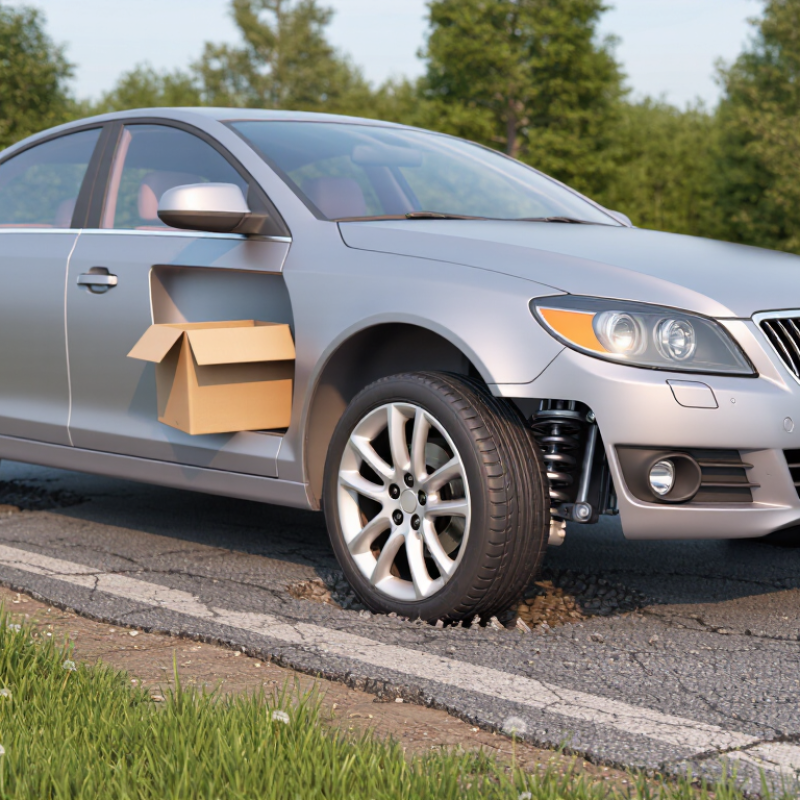
How the Suspension Controls Bouncing on Uneven Roads
When a wheel drops into a pothole, the spring compresses and then pushes back. The shock absorber, or damper, controls that spring movement by turning energy into heat. Without enough damping, the body keeps bobbing after the impact. Too much damping can make sharp bumps feel harsh. The aim is control, not a motionless ride.
The Federal Highway Administration rates pavement roughness using the International Roughness Index (IRI). Its pavement-performance thresholds classify roads at 95 inches per mile or less as “good,” and above 170 inches per mile as “poor.” Those figures describe the road, not your suspension. That distinction matters. If your car bounces repeatedly on a familiar stretch, worn dampers, loose suspension parts, or incorrect tire pressure may be contributing. NHTSA advises checking tire pressure against the vehicle’s door-jamb placard; a tire that is underinflated can feel soft and respond poorly over bumps. Still, one rough ride is not a diagnosis. Notice whether the car continues bouncing after a bump, leans excessively in turns, or shows uneven tire wear. A visual check may miss internal damper wear, so have a qualified technician inspect persistent symptoms. It is easy to blame the road alone. That can be an incomplete answer.
After a road dip a healthy suspension should settle quickly. If the car keeps bobbing, worn shock absorbers or struts may be failing to control the springs’ rebound. One bounce too many. These parts slow repeated up-and-down movement, helping the tires stay in contact with the road. When internal valves or seals wear, that control weakens. You may feel the body rise and fall after a speed bump, or notice the rear end floating over uneven pavement. The ride can feel vague, even at ordinary speeds.
Look for oily residue on a shock or strut, uneven tire wear, or extra movement after a bump. These clues are useful, but none proves the part is faulty by itself. Tire pressure, damaged springs, and worn suspension joints can produce similar symptoms. A simple push-down test may reveal excessive bouncing, though it cannot replace a proper inspection. I’d avoid treating one rough trip as a diagnosis; road surfaces and load matter. If the car continues to bounce, wanders, or feels unstable during braking, arrange a qualified inspection soon. Reduced tire contact can affect steering and stopping, so don’t ignore a change that keeps getting worse.
A car that keeps bobbing after a pothole may have weak springs or worn damping parts. Coil springs support the vehicle’s weight and help maintain ride height. When a spring weakens or breaks, one corner may sit lower, especially with the car parked on level ground. The body may also lean more during turns. That extra movement can make rough roads feel tiring. Noticeable sag matters.
Worn shock absorbers or struts can let the car bounce repeatedly because they no longer control spring movement effectively. Damaged mounts, bushings, or other suspension joints may add clunks, looseness, or uneven tire wear. Look for leaking fluid near a shock, a broken spring coil, or a tire that wears more on one edge. These clues are useful, but they do not confirm the fault by themselves. I would not blame every extra bounce on a weak spring; that assumption can point to the wrong repair. A technician can inspect ride height, suspension play, and damping safely. Have it checked. If the car feels unstable, pulls sharply, or bottoms out, avoid rough routes until it has been inspected.
| Reason | How It Can Cause Excessive Bouncing | Common Clues | Recommended Check or Action |
|---|---|---|---|
| 1. Worn or weak shock absorbers or struts | Shocks and struts control spring movement. When worn, they may not dampen suspension motion effectively, allowing the vehicle to continue oscillating after a bump. | The body keeps moving after a road dip or bump; ride control may feel reduced. | Have the units, mounts, and surrounding suspension inspected. Replace worn components according to the vehicle’s service requirements. |
| 2. Sagging or weakened coil springs | Springs support the vehicle’s weight and absorb road impacts. A spring that has lost height or strength can reduce ride height and affect suspension travel. | One corner may sit lower than the others; the suspension may bottom out more easily. | Compare ride height on level ground and have the springs checked for sagging, corrosion, or damage. |
| 3. Broken or cracked spring | A damaged spring cannot support or control the vehicle as intended and may cause uneven suspension movement. | Uneven ride height, a metallic noise, or a visibly damaged spring. | Arrange a prompt inspection. Avoid driving if the spring is broken or a tire may contact a damaged component. |
| 4. Damaged strut or shock mounts | Mounts secure suspension components to the vehicle. Worn or loose mounts can allow excess movement and transmit knocks or vibration. | Clunking over bumps, vibration, or visible movement at a mount. | Ask a technician to inspect the upper and lower mounts and replace any damaged parts. |
| 5. Worn suspension bushings or joints | Worn bushings, ball joints, or control-arm joints can let suspension parts move more than designed, affecting stability and wheel control. | Clunks, looseness, uneven tire wear, or imprecise steering may occur. | Have the suspension checked for play, cracked bushings, and loose or damaged joints. |
| 6. Damaged or worn tires | Tire damage, uneven wear, or an out-of-round tire can make impacts feel harsher or cause vibration that may be mistaken for suspension bounce. | Bulges, cuts, uneven tread, vibration, or a repeating thump. | Inspect tires and wheels. Do not drive on a tire with a bulge or other serious structural damage. |
| 7. Incorrect tire pressure | Pressure that is too high or too low can change how a tire absorbs road irregularities and can affect handling and tire wear. | The ride feels unusually firm or soft; a tire-pressure warning may appear. | Check pressure when tires are cold and use the vehicle’s specified pressure, usually listed on the driver-side door placard or in the owner’s manual. |
| 8. Excessive or uneven vehicle load | Overloading can compress the suspension and reduce available travel. An unevenly distributed load can also make the vehicle sit or respond unevenly. | The rear or one side sits low; the suspension bottoms out over bumps. | Remove excess cargo and distribute remaining items evenly. Follow the vehicle’s stated load limits. |
| 9. Incorrect or mismatched replacement springs | Springs with an unsuitable specification or different characteristics from side to side can alter ride height and suspension response. | Uneven ride height or a change in ride quality after suspension repairs. | Verify that replacement parts match the vehicle’s specifications and that paired components are suitable for the same axle. |
| 10. Damaged bump stops or limited suspension travel | Bump stops help limit suspension travel. If damaged, missing, or contacted too often because of sagging springs or excess load, impacts can feel abrupt. | A harsh thud over larger bumps or signs that the suspension frequently bottoms out. | Have bump stops, ride height, springs, and load conditions checked together to identify the underlying cause. |
Safety note: A single bounce test cannot reliably identify every suspension fault. If the vehicle bounces repeatedly, sits unevenly, makes new clunking noises, or feels unstable, arrange a professional inspection.
A car that skips or jitters over patched pavement may have a tire-pressure problem. Too little air lets the sidewalls flex excessively, which can make the ride feel soft and unsettled. Too much pressure reduces the tire’s ability to absorb small impacts, so pothole edges feel sharper. Check pressure when the tires are cold, using the vehicle’s door-jamb placard rather than the maximum number printed on the tire. Small differences matter. A gauge is more reliable than judging by appearance, since a tire can look normal while underinflated.
Inspect each tire for a sidewall bulge, deep cut, exposed cords, or uneven tread. A bulge can signal internal damage; don’t keep driving on it without professional advice. Uneven wear can offer clues: worn shoulders may point to low pressure, while a worn center can indicate overinflation. Feathered edges or one-sided wear may involve alignment or suspension problems instead. Look closely. Run your hand gently over the tread only when the car is parked safely, and watch for cupping that can cause a repeating thump. Correct pressure may help, but it won’t repair damaged tires or worn shocks. A little uncertainty remains until the tires and suspension are inspected.
When a car keeps bouncing after a bump, the suspension deserves attention, but wheel balance matters too. An imbalanced wheel often causes steering-wheel or seat vibration, especially at certain speeds. It usually does not create repeated body bounce by itself. Still, vibration can make a rough ride feel worse. A shop can check for missing wheel weights, bent rims, or uneven tire wear.
Misalignment is another clue, though it is not usually the direct cause of bouncing. A car that drifts, has an off-center steering wheel, or wears one tire edge quickly may need an alignment check. Alignment adjusts wheel angles; it does not repair worn shock absorbers or struts. That distinction is easy to miss. Have both issues assessed if symptoms overlap.
Excessive load can make the problem more obvious. Heavy cargo compresses the suspension, leaving less room to absorb a pothole before the vehicle bottoms out. Check the vehicle’s load limit in its owner’s manual, and spread permitted cargo evenly. If the rear sits low, tires rub, or bouncing continues after unloading, arrange an inspection. Note when it happens: at a certain speed, with passengers, or after one sharp bump. That small detail can help a technician narrow the cause.
Not every rough-ride problem causes repeated bouncing. This chart distinguishes factors that can directly cause repeated suspension bounce from factors more commonly linked to vibration, poor handling, or a harsh ride.
How to read it: “Yes” means the issue can directly contribute to repeated bouncing; “No” means it is not typically a direct cause. Worn or leaking dampers are a common cause of poor bounce control. Wheel imbalance usually causes speed-related vibration, while misalignment more often causes pulling or uneven tire wear. Excessive load can cause sagging or bottoming out, rather than repeated bouncing by itself. This is a diagnostic guide, not a ranking of repair frequency.
The spring compresses and pushes back. A shock absorber controls that movement by turning energy into heat. Without enough damping, the car may keep bobbing. Not instantly.
Road roughness describes the pavement, not your suspension. Notice whether the car keeps bouncing on a familiar stretch. I might blame the road too quickly; that can miss worn parts.
One corner may sit lower while the car is parked on level ground. The body may lean more in turns. Noticeable sag matters.
The car may bounce repeatedly after bumps. Damaged mounts or joints can also cause clunks, looseness, or uneven tire wear. A quick visual check may miss internal wear.
Yes. Low pressure can make the ride feel soft and unsettled. High pressure can make pothole edges feel sharper. Small differences matter.
Check when the tires are cold. Use the pressure listed on the vehicle’s door-jamb placard, not the tire’s maximum figure. A gauge is more reliable than appearance.
Check for sidewall bulges, deep cuts, exposed cords, or uneven tread. A bulge may signal internal damage. Don’t keep driving on it without professional advice.
Get persistent bouncing, pulling, clunks, or uneven tire wear checked. Avoid rough routes if the car feels unstable or bottoms out. One rough ride alone proves little.
A car’s suspension is designed to absorb bumps and keep the tires in contact with the road. If the vehicle continues bouncing after hitting an uneven surface, its suspension may not be controlling the rebound properly. Worn shock absorbers or struts can lose their ability to steady the vehicle, while weak springs or damaged suspension parts may make bumps feel harsher and allow excessive movement.
If you’re wondering “why is my car bouncing so much on bumpy roads,” also check the tires and overall vehicle setup. Incorrect tire pressure, damaged tires, or uneven tread wear can contribute to an unstable ride. Wheel imbalance and misalignment may cause vibration or poor handling, and carrying more weight than the vehicle is designed for can place extra strain on its suspension. Paying attention to when the bouncing occurs and having worn or damaged components inspected can help identify the cause and restore a more controlled ride.

Sedo Auto